Our CSR Mission & Policies
At Com Laude, we are proud that all our work is delivered within the framework of our Planet-Shaped Promise that, in everything we do, we strive to promote sustainability, inclusion and equality. We care deeply about the issues that shape society and the future of the planet. Our teams are diverse and engaged in our communities.
Our Corporate Social Responsibility Strategy (CSR) was launched over a decade ago with a consideration of the 3Ps of CSR – People, Planet & Profit:
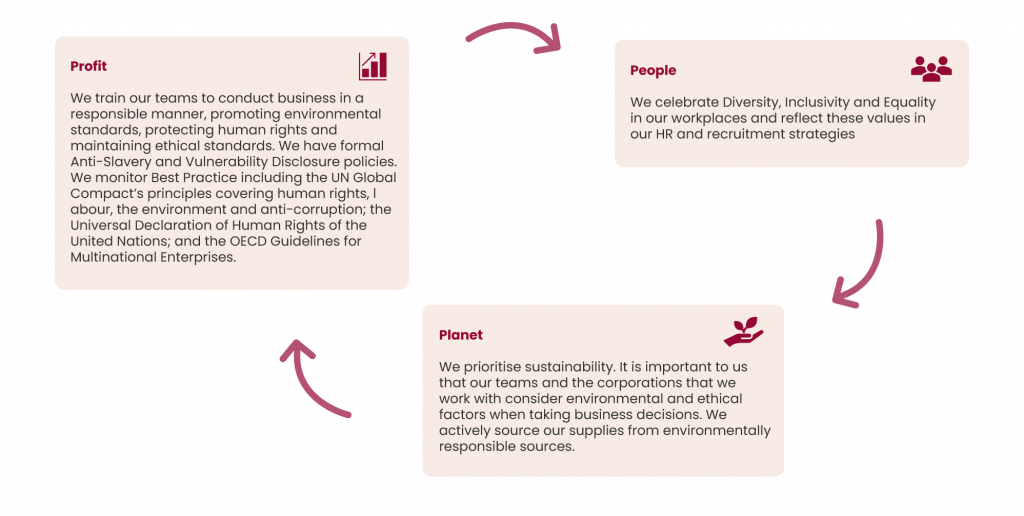
In addition, we enhanced our CSR posture by incorporating Environmental, Social & Governance (ESG) strategies and objectives into our business plans.
The result was a fresh commitment at all levels in Com Laude Group to making a positive impact. We de-centralized our efforts with the formation of a staff-led RISE Committee and an ECO Group. The Board commenced formal monitoring of our performance, so that we can understand impacts and outcomes.
Today CSR and ESG is at the heart of what we do.
At Com Laude we integrate our business values and operations to meet the expectations of our stakeholders – our customers, employees, investors, suppliers, the community, and the environment.
All our work is delivered within the framework of our Planet-Shaped Promise that, in everything we do, we strive to promote sustainability, inclusivity and equality.
Com Laude commits to:
- Developing our business towards ecological, social, and economic sustainability.
- Making our offices, operations, and supply chains as sustainable as possible.
- Working towards carbon neutral status for our operated activities worldwide, piloting new approaches to maintaining our offices, and promoting active and more sustainable lifestyles to our customers and employees.
- Reassure customers and key stakeholders that our products and services are ethically and sustainably sourced.
- Working closely with our suppliers to make sure that they respect human rights, promote decent working conditions, and improve sustainability across our supply base.
- Respecting internationally recognised human rights in line with the principles and guidance contained in the UN Guiding Principles on Business and Human Rights.
- Ensuring that our suppliers take a zero-tolerance approach to slavery, forced or compulsory labour or human trafficking.
Prevention of Pollution and Environmental Impact
Com Laude works to continuously reduce its environmental impact. Com Laude will work to build up experience and a good reputation with the environment regulators with regards to control of pollution.
Com Laude will ensure that these objectives are delivered by:
- Reporting to the Operating and Statutory board on a quarterly/annual basis through our Rise committee (Inclusion and Diversity committee).
- Group initiatives to reduce waste and packaging as much as practicably possible.
- Actively seeking to reduce our carbon footprint through various Initiatives.
Com Laude Communities and Charity
Com Laude aims to create a positive impact in society and improve people’s lives wherever possible.
Com Laude encourages our employees to become involved in their local communities and conducts fundraising events from our offices to involve employees directly.
Com Laude will ensure these objectives are delivered by:
- Com Laude supporting recognised charities via fundraising events and activities.
- Encouraging employees to volunteer to help in local communities.
- Appropriate engagement with local community groups.
Suppliers, Customers and Partners
Com Laude employees must practice honesty and integrity in every aspect of dealing with other employees, customers, suppliers, other business partners and communities.
Com Laude will ensure that these objectives are delivered by:
- Recruitment, training, and development of staff with the highest level of integrity.
- Communications through regular team meetings, guidance, and supervision.
Although Com Laude falls below the threshold under section 54 Modern Slavery Act 2015 which requires publication of a modern-day slavery statement, we fully understand our obligations to comply with this legislation. We consider matters of Slavery and Human Trafficking when entering into contractual arrangements as part of a zero-tolerance approach that aligns with our values and pass this requirement contractually down our supply chain.
For further information, contact any of the leaders of Com Laude.
Com Laude works with brands to maximise their ability to do business online. We do this through strategic domain name management, protecting against cyber-attacks, and counteracting digital brand infringement. As part of this we are committed to providing secure, stable and resilient infrastructure and systems for our clients.
Scope
This policy applies to persons who identify vulnerabilities in our systems and who are not affiliated with Com Laude and its related corporate entities. If you are a client of ours, we recommend you contact your Domain Strategist.
Definitions:
For the purpose of this policy, the following definitions apply.
Com Laude System: any system that is owned, controlled or managed by the Com Laude Group, including its related corporate entities.
Finder: any legal or natural person who identifies a potential Vulnerability in the Com Laude System.
Reporter: the person who originates the message of a potential Vulnerability to Com Laude (often the same person as a Finder).
Vulnerability: a flaw or weakness in a system’s design, implementation, or operation and management that could be exploited to violate the system’s security policy.
Reporting a Vulnerability
If you find a Vulnerability in a Com Laude System, we ask that you report it to us at vulnerabilities@comlaude.com straight away so that we can remediate the Vulnerability as quickly as possible. We ask that Finders and Reporters:
a. do not disclose the Vulnerability to any other party to mitigate the risk of others maliciously utilising the Vulnerability;
b. do not exploit a security issues that you discover for any reason;
c. make a good faith effort to avoid privacy violations and disruptions to others, including but not limited to unauthorised access to or destruction of data and interruption or degradation of our services; and
d. do not access user data or company data including but not limited to personally identifiable information and data relating to an identified or identifiable natural person as Finders and Reports are not authorised to do so.
When reporting a Vulnerability, we ask that you include screenshots, a description of the process you used to identify the Vulnerability, the time and date of discovery, and any other information that would allow us to replicate or otherwise verify the Vulnerability. After reporting a Vulnerability, we ask that Finders and Reporters do not engage in further scrutiny or exploitation of the Vulnerability.
Legal Action
We take cyber security seriously at Com Laude and always appreciate those who take the time to report Vulnerabilities. We will not take legal action against Finders or Reporters if they adhere to this policy and if:
a. they do not compromise the availability, security or privacy of Com Laude Systems; or
b. they have received prior written permission from Com Laude to engage in vulnerability or penetration testing and the identification of the Vulnerability is within the scope of our written permission.
This is contingent on Finders and Reporters:
a. Not violating any applicable laws or regulations; and
b. Not publicly sharing the Vulnerability or related details until Com Laude has remediated the Vulnerability. For the avoidance of doubt, this does not permit Finders or Reporters to share details of a Vulnerability unless Com Laude provides written permission in advance to do so.
Remediating the Vulnerability
Once we have verified the Vulnerability, we will follow our internal processes to remediate the Vulnerability. The time to develop and deploy a remediation for a Vulnerability will be on a case by case basis and will be based largely on our own internal categorisation of the impact and exploitability of the Vulnerability. We will inform you after we have deployed a remediation for the Vulnerability.
Public Awareness of Vulnerabilities
The majority of the Com Laude Systems are internal or client facing and not available to the public. In most instances we will only share the details of the Vulnerability with the affected parties, that is, our clients and staff. However, this will depend on the nature of the Vulnerability. For example, we would always disclose data breaches where required by law.
Last updated: June 2026
Reporting Period: January 2025 – December 2025
This page outlines how Com Laude measures, reports, and improves its greenhouse gas emissions in line with recognised international standards.
Our Commitment
Com Laude Group is committed to transparent environmental reporting and continuous improvement in greenhouse gas (GHG) emissions management.
Our emissions are calculated in accordance with the principles of the GHG Protocol Corporate Accounting and Reporting Standard using the operational control approach and are disclosed as part of our ongoing commitment to the Carbon Dislosure Project (CDP), our EcoVadis certification, and the Science Based Targets initiative (SBTi).
Reporting Scope
This disclosure covers 2025 emissions, with 2024 presented as a recalculated baseline to provide a consistent basis for comparison.
In January 2026, Com Laude Group acquired Markmonitor, significantly expanding the Group’s operational footprint. This acquisition is not included in the 2025 reporting boundary and will be incorporated from 2026 onwards to ensure consistency and comparability.
Methodology & Data Improvement
Com Laude is continually improving the quality and completeness of its emissions reporting.
Earlier disclosures were based primarily on high-level estimates using a limited access approach supported by third-party tools.
The Group is transitioning toward more granular, activity-based emissions accounting. This approach ensures more comprehensive coverage of emissions while progressively increasing the proportion of primary (measured) data over time.
As a result, 2024 emissions have been recalculated to reflect improved data quality, methodological accuracy, and consistency across reporting years.
Relevant indirect emission sources are assessed and included where data is available. We are making ongoing efforts to improve completeness over time.
Operational Boundary Update
Following a reassessment of the Com Laude reporting and application of the operational control approach, certain emissions previously reported under Scope 1 and Scope 2 have been reclassified to reflect leased and serviced office environments where utilities are managed by third parties.
This update provides for alignment with the GHG Protocol and enhances transparency. The resulting changes in reported emissions reflect improved classification and data accuracy rather than a reduction in underlying environmental impact.
Recalculation of Previously Reported Emissions
2024 emissions have been recalculated following improvements to the company’s reporting methodology, data quality, and operational boundary assessment. As a result, the reported emissions may differ from those disclosed previously. These changes reflect methodological enhancements and more accurate classification of emissions, rather than changes in the company’s underlying environmental performance.
2025 emissions have been prepared using the same methodology, providing a consistent and comparable basis for year-on-year reporting
Year-on-Year Emissions Performance (2024 –2025)
Using the recalculated baseline, 2025 emissions are higher than 2024.
This increase is primarily attributable to higher levels of business travel, reflecting greater in-person meetings, events and operational activity during the reporting period. Other operational factors, including changes in office occupancy and business activity, also contributed to the year-on-year movement.
Science-Based Target
Com Laude Group has an approved near-term target validated by the Science Based Targets initiative:
- Reduce absolute Scope 1 and Scope 2 emissions by 50% by 2030 (base year: 2024)
- Commitment to ongoing improvement in value chain emissions
Following the recalculation of the baseline, the Group confirms that its target remains unchanged and continues to align with a 1.5°C pathway.
Our Approach to Emissions Reduction
The Group is focused on reducing its environmental impact through a combination of operational efficiency, behavioural change, and responsible business practices. Key initiatives include:
- Improving energy efficiency and refrigerant management in office environments
- Reducing electricity consumption intensity across locations
- Minimising non-essential business travel through virtual collaboration
- Strengthening sustainable procurement practices
- Supporting hybrid working and improving waste management practices
Where travel is necessary, the Group aims to prioritise lower-carbon options, including selecting efficient flight routes, using eco-certified accommodation, and choosing low-emission local transport.
Data & Transparency
Our greenhouse gas emissions inventory is calculated using recognised methodologies and the best available operational data. Where direct data is not yet available, appropriate estimation techniques are applied to ensure completeness and consistency. We continually improve our data quality and reporting processes to enhance the accuracy and transparency of our environmental reporting.
The inventory covers Scope 1, Scope 2 (location-based), and relevant Scope 3 emissions categories in line with the GHG Protocol Corporate Accounting and Reporting Standard.
While data quality has improved significantly, certain emissions continue to rely on estimation where primary data is not yet available, particularly in leased office environments. Conservative estimation methods are applied.
Our Approach
Com Laude is committed to transparent, reliable and continually improving environmental reporting. By strengthening our greenhouse gas inventory and enhancing the quality of our data, we aim to provide stakeholders with a robust foundation for understanding our environmental performance and tracking progress towards our long-term climate commitments.